Classification
- Sieve particle-size distribution
- Hydrometer analysis
- Soil pH
- Electrical conductivity
 SANAS T1018
Know the ground
Site investigation, sampling and laboratory testing turn hidden ground conditions into evidence for foundation, pavement and development decisions.
Field investigation
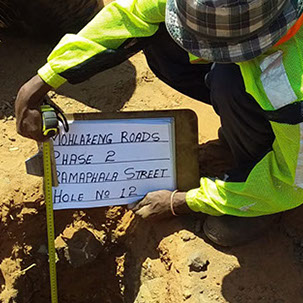
Investigation programmes can combine test-pit excavation and profiling, sampling, in-situ testing and laboratory classification to build a practical understanding of ground conditions.
Laboratory
Specialist laboratory work supports classification and assessment of soil behaviour under loading, drainage and shear conditions.
Detailed capability
Public test guide
Each test opens a plain-language page explaining what is used, what is measured and how the result supports a project decision.
Checks whether an unsaturated soil may suddenly compress when it becomes wet under load.
↗02Pushes an instrumented cone into the ground to obtain a continuous profile of resistance with depth.
↗03Measures water flow through a relatively permeable soil while a constant hydraulic head is maintained.
↗04Measures the resistance of soil to sliding along a controlled horizontal plane.
↗05Compares matching soil specimens tested at different moisture conditions to assess wetting-related settlement behaviour.
↗06Uses repeated hammer blows to measure how easily a cone penetrates the ground or pavement layers.
↗07Measures how readily water flows through relatively low-permeability soil.
↗08Assesses how much an expansive soil may increase in volume and the pressure it can develop when wetted.
↗09Measures the very fine silt and clay particles that are too small to separate accurately with normal sieves.
↗10Measures the density and moisture of compacted material at its constructed position.
↗11Measures the amount of water present in a soil or construction-material sample.
↗12Measures how a confined soil specimen compresses with time under vertical loading.
↗13Separates a soil or gravel sample into size ranges to show how much coarse and fine material it contains.
↗14Applies controlled load to a rigid plate on the ground and measures the resulting settlement.
↗15Measures how much dry soil mass is contained in a known total volume.
↗16Measures how readily a soil extract conducts electricity, which indicates the level of dissolved salts.
↗17Shows whether a soil-water mixture is acidic, neutral or alkaline.
↗18Opens the ground so soil layers, moisture, fill and other visible conditions can be logged and sampled directly.
↗19Loads a cylindrical soil specimen under controlled confining pressure to measure its strength and deformation.
↗20Recovers soil with as little disturbance as practical so its structure can be tested in the laboratory.
↗Make informed project decisions